My training is best known for fast, happy and healthy dogs, tight turns and, of course, running contacts. By now, there are so many dogs trained that way, that I can't keep track anymore, but you can see the first 20 dogs, trained by my method, here. To see more, please go to videos or use YouTube. For an explanation of the method, go to FAQ: My running contacts.
The obvious advantage of this method is that… It’s the fastest one. The fastest dog-walk of Bi that I have on video is 1.2s, from Bu 1.3s and from La 1.4s (measured from the time when first paws make a contact with a plank to the time when last legs leave it). Most of the dogs, trained by this method, have 1.4 to 1.6s, in maximum 1.7s dog-walks, some have even 1.2s dog-walks.
Many people mail me to ask why I don’t write a book… Here is your answer: because I can tell everything that I think is important for success in agility in 10 paragraphs:
1. develop a firm and trusting relationships with your dog
2. properly condition your dog: my dogs’ minimum is 2
hours off of leash running in the woods per day + one all-day-long hike in the mountains per week
3. teach your dog tricks – as many as you can think of: tricks teach you how to teach, they teach your dog how to learn and they also teach the dog that learning is fun, that you’re fun. Side effect is total awareness of his body, tricks teach a dog how to use his body. I guarantee you that if you teach your dog 100 tricks, you won’t have jumping problems. Rear end and overall body awareness, balance, strength, power, flexibility and agility that my dogs excel in so much are all the side-effects of all the tricks they’ve learned. "Too much tricks" doesn't exist. If you don’t have any ideas, you can get some from our tricks videos.
4. teach your dog obedience, obedience in high-drive of course. It’s very easy to motivate a dog for those 30s on agility course. It’s much harder to motivate your dog for long minutes of just heeling. If you want to learn about motivation, obedience is a way to go. If you can make those long minutes of heeling fun to a dog, then making agility fun for your dog should be a piece of cake.
5. boost your dog’s confidence – only confident dog will dare to run at his maximal speed. Make sure your dog knows he is World Champion before you let him do his first jump.
6. don’t be afraid to do things your way. Books, videos and seminars are helpful, but no one knows your dog better as you do, especially after teaching him those 100 tricks and playing and walking with him every day, so… Trust your intuition and do what YOU think is best for your dog. Avoid those that think there is just one best way. Wary those that want to make you believe you need particular breed/method/handling tool/video in order to succeed. Were you told too that you MUST have a lead-out in order to win? Well, I win at least 90% of my runs with La. And she doesn’t stay.
7. if something goes wrong, always remember it’s your fault, caused either by your training or handling. That’s good news since it gives you a power to fix it yourself too. Things would be much harder if it was dog’s fault. Luckily, they, unlike people, come without mistakes.
8. never forget that results don’t count. Because of the speed of my dogs, I can have a very ugly run and still win. And I might go off-course sometimes, but that doesn’t mean that the rest of the run wasn’t perfect. Who would care about that off course then anyway? I always say that every good dog goes off-course sometimes – that’s not the case only if handler is perfect too. But I don’t know any of those, so…
9. dogs work best when they work for themselves. Don’t ask them for a favour to work with you. Make them ask you for a favour to work with them.
10. you want agility training tips? If you follow the advise from above, agility gets so easy that you don’t need those. Just go out and have fun with your dog!
There is no big difference between training your dog for tricks, obedience or agility, it's all the mix of everything and you can learn the most about it from your dog. Still, as I'm getting so many requests for videos, you can now order:
Also, while answering all the training questions I get by mail, I actually already almost wrote a book... And to make it useful for others too, I gathered them in the following articles that are mostly copy paste from my correspondence with visitors of this site, mostly in simple form of answers to "frequently asked questions":
- Agility is good for dogs, some of my thoughts on working young dogs, written as a reply to those that think I work too much with puppies for their phisical and mental good. As you can guess: I don't agree. Read why.
- Agility is good for dogs part II, some additional explanation on working puppies topic
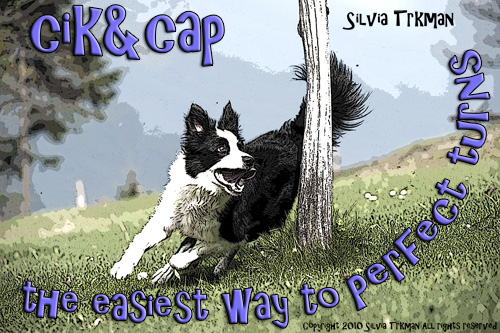
- Our famous cik&cap, explanation of my famous cik&cap turns
- Teaching a trick is the least important part of teaching tricks
- Behind The Scenes, on trick training and LolabuLand video production
- FAQ on training see-saw, weave-poles, speed and more
- FAQ on puppy and tricks training
(also see puppy class video and of course my puppy updates)
- FAQ on everyday life with my dogs
- FAR (Frequent Accusations Rejected): FAR from truth
- FearShep?, an answer to questions on how problematic or not fearfulness is in PyrSheps
You can find some more on my training philosophy in the following interviews:
(This article originally appeared in the September 2005 issue of Clean Run, the magazine for dog agility enthusiasts.)
- training articles, written for Slovenian dog magazine Moj pes (in Slovenian language only)
If you want to know more, come back later, subscribe to one of the seminars I hold or organize one yourself.:) Please contact me to check with my schedule – so far, I had seminars all around USA, in Brazil, UK, Norway, Sweden, Finland, Portugal, Spain, Italy, France, Belgium, Netherlands, Germany, Austria, Switzerland, Hungary, Poland, Czech Republic.
Also, see

